

1067
TL;DR
- Being constantly active online doesn't always mean you're being productive.
- Frequent notifications and digital distractions interrupt deep focus and reduce work quality.
- Every interruption forces your brain to refocus, wasting time and mental energy.
- Understanding online noise vs mental clarity helps you recognize the difference between staying busy and making meaningful progress.
- Protecting your attention creates space for deeper thinking, better creativity, and greater productivity.
Your mind was never designed to process hundreds of notifications, endless opinions, short videos, emails, and breaking news every single day. Yet, for many people, this has become the new normal. The result is a brain that feels constantly busy, even during moments of rest. You may find it harder to focus, make decisions, or simply enjoy quiet moments without reaching for your phone.
This is where the conversation around online noise vs mental clarity becomes increasingly important. Every digital interruption competes for your attention, leaving little room for deep thinking, creativity, or emotional balance. Understanding the difference between online noise and mental clarity is not about rejecting technology altogether. Instead, it is about learning how constant digital stimulation affects your mind and discovering practical ways to create space for clearer thinking, better focus, and a healthier relationship with the online world.
Compare habits that drain vs. support your mind-
| Online Noise | Mental Clarity |
| Constant notifications and distractions | Focused attention on one task |
| Endless scrolling and information overload | Intentional consumption of useful information |
| Frequent context switching | Deep, uninterrupted work |
| Comparison and FOMO | Self-awareness and contentment |
| Reactive decision-making | Thoughtful, deliberate choices |
| Mental fatigue and stress | Calm, balanced mindset |
| Reduced productivity | Improved efficiency and creativity |
| Poor sleep from excessive screen time | Better rest through healthy digital habits |
The Rise of Digital Overstimulation
The human brain was not constructed to handle the amount of information we receive every day. Every scroll, every click and every notification requires some attention, even a couple of seconds. This divided attention over time conditions the brain to remain in a state of alertness.
This hyperstimulation causes mental exhaustion. The mind keeps jumping around thoughts, re-watching what we have already watched online, or waiting till the next notification arrives, even when we are physically resting. This is one of the core reasons the debate has become so relevant in modern wellness discussions.
Also read: Dopamine Detox for the Digital Age: Small Habits That Reset Your Brain
How Online Noise Affects Focus
Internet websites are designed in a way that they keep potential consumers entertained as long as they can. Algorithms give preference to the content that evokes emotional responses, urgency, or curiosity. Although this design makes people scroll, it undermines sustained attention.
Once they get used to consuming content quickly, paying attention to one single task, whether it is reading, studying, thinking, or reflecting, becomes challenging. Concentration is interrupted, and the clearness of the mind is lost. This absence of attention is one of the most obvious effects of internet overload in the case of online noise vs mental clarity.
Emotional Impact of Constant Connectivity
In addition to focus, online noise has an impact on emotional well-being. Comparison, anxiety and emotional burnout can be generated due to exposure to idolized lifestyles, views, positions and negative news. Emotions that are not directly related to personal life experiences are always in the mind processing.
The surroundings of these emotions do not give much room to self-awareness. Emotional balance is what is necessary in mental clarity, but when it comes to online noise, their emotions are left in a reactive position.
Decision Fatigue and Mental Exhaustion
Micro-decisions are needed on every bit of online content, to either click, respond, like, ignore or save. With time, such decisions accumulate to bring about decision fatigue. The brain gets fatigued, thus it becomes difficult to think properly or make sound decisions.
Mental clarity flourishes through simplicity and less mental load. Nonetheless, the noise in the online world clogs the mind with irrelevant options, leaving less thinking capacity to think significantly. This is a continuous conflict between online noise vs mental clarity, which influences productivity, creativity, and emotional control.
Reduced Self-Reflection
Mental clarity is a product of stillness, sometimes a time of contemplation, time to process feelings, and just being there. These moments are substituted by online noise. The silence is uncomfortable, and the mind wants to be distracted as opposed to introspection.
Reflections are raw until processed. The accumulation of ideas, emotions, and stress leads to inner chaos. This is the reason why the equilibrium between online noise vs mental clarity plays a very crucial role in personal development and self-understanding.
Also read: Simple Daily Reflection Questions That Improve Self-Awareness
The Illusion of Productivity
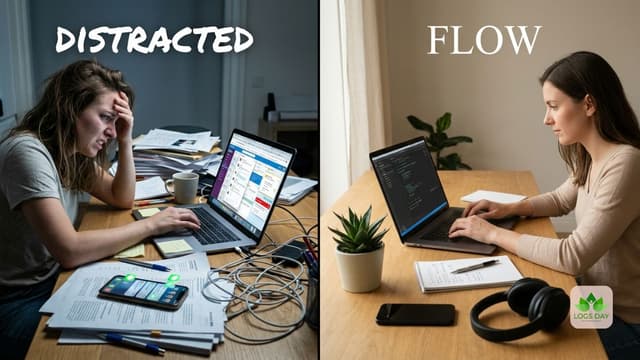
Being busy online often feels like being productive, but the two are rarely the same. Checking emails, replying to messages, switching between apps, reading articles, and scrolling through social media can create the impression that you're getting a lot done. In reality, these constant digital activities often keep your brain occupied without helping you make meaningful progress.
True productivity comes from uninterrupted focus. Whether you're solving a problem, learning a new skill, writing, or making important decisions, your brain performs best when it can stay on one task for an extended period. Every notification, tab switch, or quick glance at your phone forces your attention to reset, making it harder to regain momentum. Over time, this constant interruption drains mental energy and reduces the quality of your work.
This is one of the clearest examples of online noise vs mental clarity. While online noise encourages constant reaction and multitasking, mental clarity allows you to think deeply, work intentionally, and accomplish more with less mental effort. The more you protect your attention from unnecessary digital distractions, the easier it becomes to enter a state of deep focus where your best ideas and most meaningful work can happen.
Impact on Sleep and Recovery
Online noise does not stop when the day ends. Even when the body is tired, the brain remains alert, and that is through late-night scrolling, notifications, and exposure to the screen. This postpones mental shutdown and declines sleep quality. Sleep deprivation also affects mental clarity, and it is a vicious circle as fatigue impairs digital consumption, and digital consumption impairs fatigue. This cycle can be stopped by understanding online noise vs mental clarity, which acknowledges the importance of boundaries in mental recovery.
Reclaiming Mental Clarity in a Digital World
Mental clarity does not dictate the rejection of technology. It requires intentional use. Setting up digital barriers like reducing screen time, fewer alerts, and planned moments offline can restore balance.
The brain can be put back into gear by practices such as mindful consumption, single-tasking, and taking regular digital breaks. Once the online noise is cut, the mind gets back to focusing, thinking, and relaxing in its usual manner. This change turns the conflict between online noise and mental clarity into coexistence.
Also read: Why Phone Addiction Feels Stronger Than Before
Expert Insights
Experts in digital wellbeing and neuroscience shed light on how constant digital stimulation affects our minds and why intentional mental boundaries support clarity.
According to Dr. Newport, the overwhelming use of digital devices causes disjointed attention and limits the ability to think deeply, which he describes as attention residue. He stresses that it is better to reduce low-value online communication and create purposeful focus practices that will help you think better.
Similarly, Dr. Brewer also observes that constant consumption of online content causes habitual craving cycles in the brain, which can be observed among habit loops. This constant stimulation makes the brain more fatigued and distracted, and it becomes more difficult to have clarity without having a conscious break away from the digital noise.
Final Words
The modern mind is dealing with more stimulation than ever before. Online noise vs mental clarity isn’t about fighting the digital world—it’s about reshaping how we relate to it. The mind is reactive, scattered, and fatigued when online noise prevails. In cases where the importance of mental clarity is given priority, concentration, relaxation, and self-awareness are restored. With the development of purposeful online routines and appreciation of mental calmness, clarity can be attained, even in the online noise.
Also read: Why Calm Homes Are Trending in a Loud, Always-On World
At Logsday, we see wellness and personal development as a conscious choice. Step back from online noise and reclaim mental clarity.
Sources
- https://www.calnewport.com/on-digital-minimalism/
- https://www.penguin.co.in/book/digital-minimalism-choosing-a-focused-life-in-a-noisy-world/
- https://www.mindful.org/break-the-cycle-of-stress-and-social-media-learn-a-3-step-process-that-builds-healthy-habits/
- https://www.health.harvard.edu/mind-and-mood
- https://www.ncbi.nlm.nih.gov/